
From Zero to Backend Developer: A 2026 Self-Study Roadmap
A practical 6-month self-study plan for becoming a backend developer in 2026 — language choice, data structures, databases, APIs, and the books that take you from beginner to job-ready.
Backend development in 2026 is more accessible than ever — and also more crowded. The frameworks have multiplied, the tooling has become opinionated, and "just learn a language" is no longer useful advice. This guide is the roadmap we wish every self-taught backend developer had on day one: what to learn, in what order, and which books actually move you forward instead of around in circles.
If you are starting from zero and can give this six to nine months of honest effort, you can absolutely reach a junior backend role. The pyramid below is the structure the rest of this article follows.
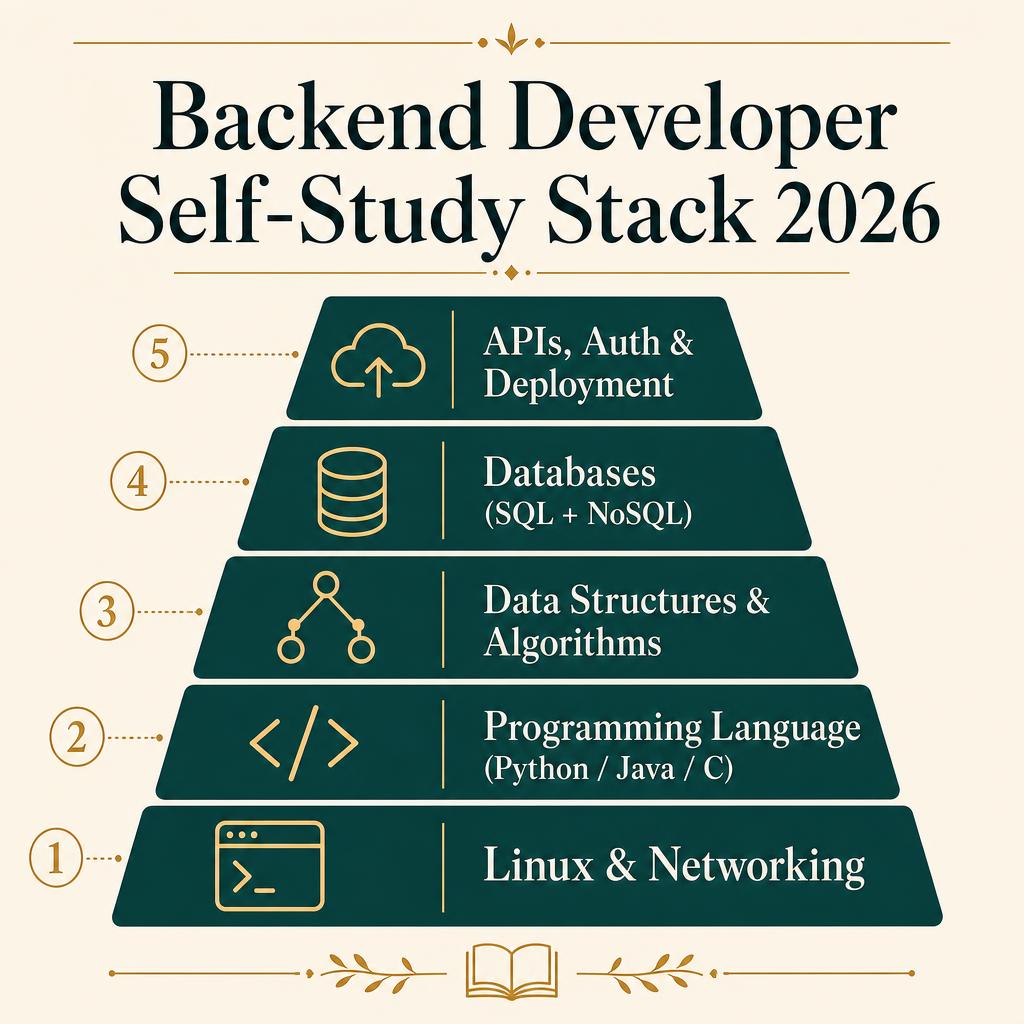
Stage 1 — Linux, the shell, and how the internet actually works
Every backend job sits on top of a Linux server you will eventually have to debug. Spend the first two weeks here, not the last two days before an interview.
- File system, processes, permissions, package managers
- `ssh`, `grep`, `awk`, `cat`, pipes, redirection, `journalctl`
- HTTP/1.1 vs HTTP/2, status codes, headers, cookies, CORS
- DNS, TCP vs UDP, what actually happens when you type a URL
We recommend working through Beginning Linux Programming as your reference. It is one of the few books that respects the reader's time and gets you to confident shell usage without three hundred pages of history.
Stage 2 — Pick one language and go deep
A common beginner mistake is hopping between languages. Pick one, ship two projects with it, then evaluate. For backend in 2026, the realistic shortlist is Python, Java, or modern C/C++. JavaScript is fine too but Node-specific resources are a separate track.
| Language | Best for | Hiring market | Starter book |
|---|---|---|---|
| Python | APIs, data, scripting, AI glue | Largest, most beginner-friendly | Python Programming |
| Java | Enterprise, Android backends, big systems | Stable, high-paying | Java Programming for Beginners |
| C / C++ | Systems, performance, embedded backends | Specialised, well-paid | C Programming Language and C++ Programming Language |
| PHP | LAMP stacks, WordPress, legacy SaaS | Niche but evergreen | Learning PHP and MySQL |
Whichever language you pick, the goal of Stage 2 is the same: read input, transform it, write output, handle errors, and test your code. If you can build a small CLI tool that talks to an API and writes results to a file, you are ready for Stage 3.
Don't skip the fundamentals
Beginners often skip language fundamentals because tutorials feel slow. Resist that. Knowing exactly how strings, lists, dictionaries and references behave in your chosen language is the single highest-leverage skill in the first year. Type out every example. Break it. Fix it. Re-type it.
Stage 3 — Data structures and algorithms (the right amount)
You do not need to grind a thousand problems. You need to understand the dozen structures that appear in real backend code every week, plus the algorithmic intuition to reason about cost.
- Arrays, linked lists, stacks, queues, hash maps, sets
- Trees (binary, BST, heap), tries, graphs
- Sorting, searching, two-pointer, sliding window, BFS/DFS
- Big-O for time and space — not as a quiz, as a habit
Data Structures and Algorithms is the textbook we send people to most often. It is concise, language-agnostic, and the exercises actually pay off. Pair it with 50–80 practice problems on whichever platform you like, and you have cleared the algorithmic bar for almost every junior backend interview.
Stage 4 — Databases: SQL first, NoSQL second
This is the stage that separates beginners from junior hires. Most production bugs are database bugs. Most performance work is query work. Spend serious time here.
Start with relational. Learn `SELECT`, `JOIN`, `GROUP BY`, indexes, transactions, and isolation levels. Then learn one document store (MongoDB or DynamoDB) and one key-value store (Redis). Database Management System covers the theory — schemas, normalization, ACID — that no random YouTube tutorial will give you in a coherent way.
Checklist for Stage 4
- Design a schema for a small app from scratch (users, posts, comments, likes)
- Write the five queries that power its main pages
- Add the indexes those queries need — and explain why
- Move one query to Redis as a cache and measure the difference
If you can do all four without copy-pasting, you have a real database skill.
Stage 5 — Building actual APIs
Now you stitch everything together. Pick a framework in your chosen language — FastAPI or Django for Python, Spring Boot for Java, Express or Fastify for Node — and build at least two non-trivial APIs end to end.
At minimum, each project should ship:
- REST endpoints with proper status codes and validation
- Authentication (email/password plus one OAuth provider)
- A relational database with at least three related tables
- Error logging and structured request logging
- A deploy pipeline to a real URL (Render, Fly, Railway, or a small VPS)
- A README that explains the architecture in five paragraphs
The README matters as much as the code. Hiring managers skim repos in 90 seconds. A clear README is what gets you the call.
Stage 6 — Auth, security, and the things that fail in production
The last stretch is the unglamorous one and the reason senior engineers exist: security, observability, and operating real systems.
- Password hashing, JWT vs sessions, refresh-token rotation
- SQL injection, XSS, CSRF, rate limiting, input validation
- Logs, metrics, traces — pick one stack and use it
- Backups, migrations, zero-downtime deploys
- Reading other people's code without panicking
The Software Testing volume is a useful companion here — most backend bugs are caught (or missed) at the testing boundary, and a structured grasp of unit, integration and contract testing is what makes your code trustworthy in a team.
A realistic six-month schedule
| Month | Focus | Output |
|---|---|---|
| 1 | Linux, shell, HTTP, Git | Personal dev environment, dotfiles repo |
| 2 | Language fundamentals | 1 small CLI app, 1 scraper |
| 3 | Data structures & algorithms | 60 solved problems, notes per topic |
| 4 | SQL and one NoSQL store | Schema + queries for a sample app |
| 5 | First real API project | Deployed app with auth and a database |
| 6 | Second project, polish portfolio, apply | Two repos, a clean README, an active GitHub |
If you slip by a month, fine. If you slip by three, look at what stage you skipped — almost always it is Stage 1 or Stage 4.
What to skip in 2026
- Anything claiming to teach you ten frameworks in a weekend
- Tutorials that never make you type the code
- Microservices, Kubernetes, and "clean architecture" before you have shipped a monolith
- Brand-new languages for production work in your first year
- Long video courses without a project at the end
The shortest path to a backend job is still the unglamorous one: one language, one database, one framework, two finished projects, and a portfolio that proves you can deliver.
Where Knowledge Flow Books fits in
We publish the foundations-first textbooks that this roadmap is built around. The full set lives in our computer science and programming series, and the most relevant titles for a backend self-study plan are:
- Python Programming — Stage 2
- Java Programming for Beginners — Stage 2
- Data Structures and Algorithms — Stage 3
- Database Management System — Stage 4
- Beginning Linux Programming — Stage 1
- Software Testing — Stage 6
Bookmark this page. Work the stages in order. In six months, the only thing standing between you and your first backend role is the second project — start building it today.
By Knowledge Flow Editorial Team
Last updated: