
Best Engineering Foundation Books for Self-Study
A practical guide to choosing engineering foundation books for self-study, with clear routes through mechanics, electronics, fluid mechanics, and technical fundamentals.
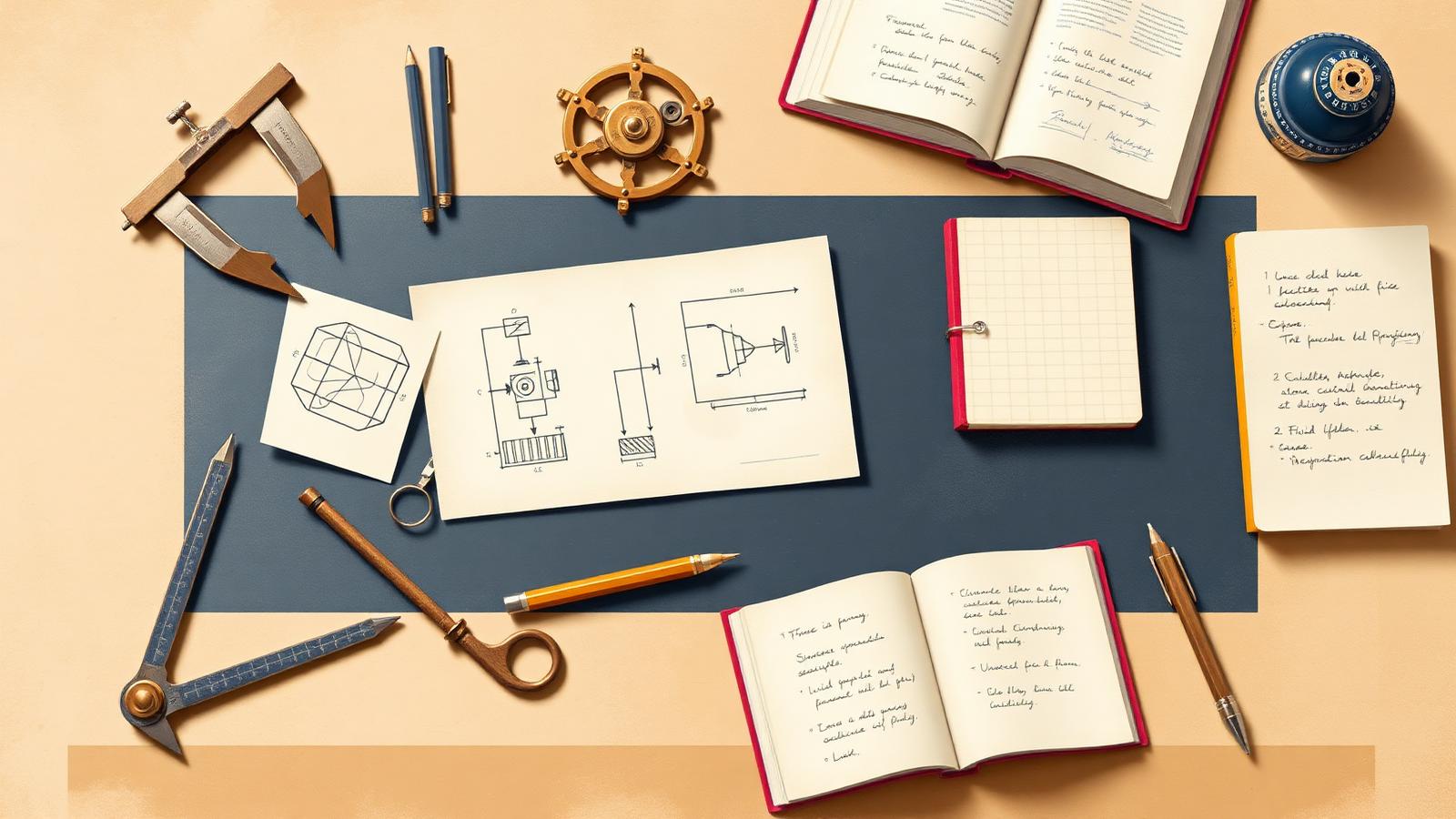
Engineering is easiest to learn when the foundations are sequenced clearly. The most effective self-study plan does not begin with the thickest reference book on the shelf — it begins with the concepts that make later formulas feel inevitable: units, diagrams, force balance, energy, circuits, measurement, materials, and systems thinking.
For learners rebuilding the basics, the best engineering foundation books are the ones that explain the language of the discipline before asking the reader to solve advanced problems. That is the editorial reason Knowledge Flow Books keeps engineering titles compact, direct, and topic-led. A student should be able to understand what a chapter is for, what problem it solves, and how it connects to the next subject.
The five foundation subjects, mapped to books
Every engineering discipline eventually rests on the same handful of foundation subjects. Before you buy a stack of reference texts, get one concise book per foundation and read it end to end. The table below maps each Knowledge Flow foundation title to the specific study focus it develops.
| Foundation Subject | Recommended Book | Study Focus |
|---|---|---|
| Mechanical measurement | Mechanical Instruments and Tools | Measurement literacy, tool selection, workshop practice |
| Fluid & thermal reasoning | Basics of Fluid Mechanics | Pressure, flow, energy transfer, control volumes |
| Electrical fundamentals | Electrical and Electronics Engineering | Circuits, machines, and control basics |
| Electronic systems | Electronics Engineering | Components, signals, and systems |
| Digital & communication | Information and Communication Technology | Sensors, software, networks vocabulary |
Start with mechanical reasoning
Mechanics teaches how engineers translate real objects into simplified models: a beam, a lever, a rotating shaft, a control volume, a tool, or a machine element. Readers who need this base can begin with Mechanical Instruments and Tools, then move into Basics of Fluid Mechanics when they are ready to think about pressure, flow, and energy transfer.
Do not just read chapters. Aim to fully rework 8–12 solved examples per subject before moving on — copy the problem, close the book, redraw the free-body or control-volume diagram from scratch, and solve. The examples you can reproduce cold are the ones you actually understand.
Add electrical and electronics fundamentals
Even students outside electrical engineering benefit from knowing how circuits are described, measured, and controlled. Electrical and Electronics Engineering gives a practical entry point, while Electronics Engineering helps readers connect components, signals, and systems.
This foundations-first sequencing mirrors university introductory curricula — for example, MIT's introductory EECS curriculum on OpenCourseWare deliberately starts from measurement, circuits, and signals before layering on higher abstractions. The same order works for a self-study learner at home.
Do not skip information and communication technology
Modern engineering work touches sensors, software, networks, data, or automation. A foundations-first learner can use Information and Communication Technology to build the vocabulary needed for technical workplaces and interdisciplinary study.
Suggested time allocation
If you have roughly 100 hours to invest in a first pass across foundations, weight the split toward the subjects with the most transferable models. The chart below is an illustrative allocation — adjust for your own discipline (mechanical students should push mechanics higher; ECE students should push electrical/electronics higher).
A five-week self-study sequence
You do not need to buy ten books at once. Choose one subject, finish a concise foundation text, then add the next layer. A five-week starter plan looks like this:
| Weeks | Focus | Anchor book |
|---|---|---|
| Week 1–2 | Mechanics & measurement | Mechanical Instruments and Tools |
| Week 3 | Fluids & energy transfer | Basics of Fluid Mechanics |
| Week 4 | Electrical & electronics | Electrical and Electronics Engineering / Electronics Engineering |
| Week 5 | ICT & systems | Information and Communication Technology |
At the end of each week, write a one-page summary in your own words, solve or recreate the example problems, then explain the idea aloud without looking at the book. If the explanation fails, reread the concept before collecting more resources. Engineering knowledge compounds only when the core model is stable.
Where to go next
Once foundations are stable, the natural next subject for most engineering learners is thermodynamics — it ties mechanics, fluids, and energy together into one framework. If thermodynamics is next on your list, see our self-study guide to thermodynamics.
Browse the full Engineering Core Series or visit the Knowledge Flow Books catalog to compare related subjects across engineering, computer science, business, and medical sciences.
By Knowledge Flow Editorial Team
Last updated: