
How to Read a Textbook Effectively
Most students read textbooks the wrong way — front to back, highlighter in hand. Here is the method cognitive scientists actually recommend: SQ3R, active recall, and spaced retrieval. Same time, three times the retention.
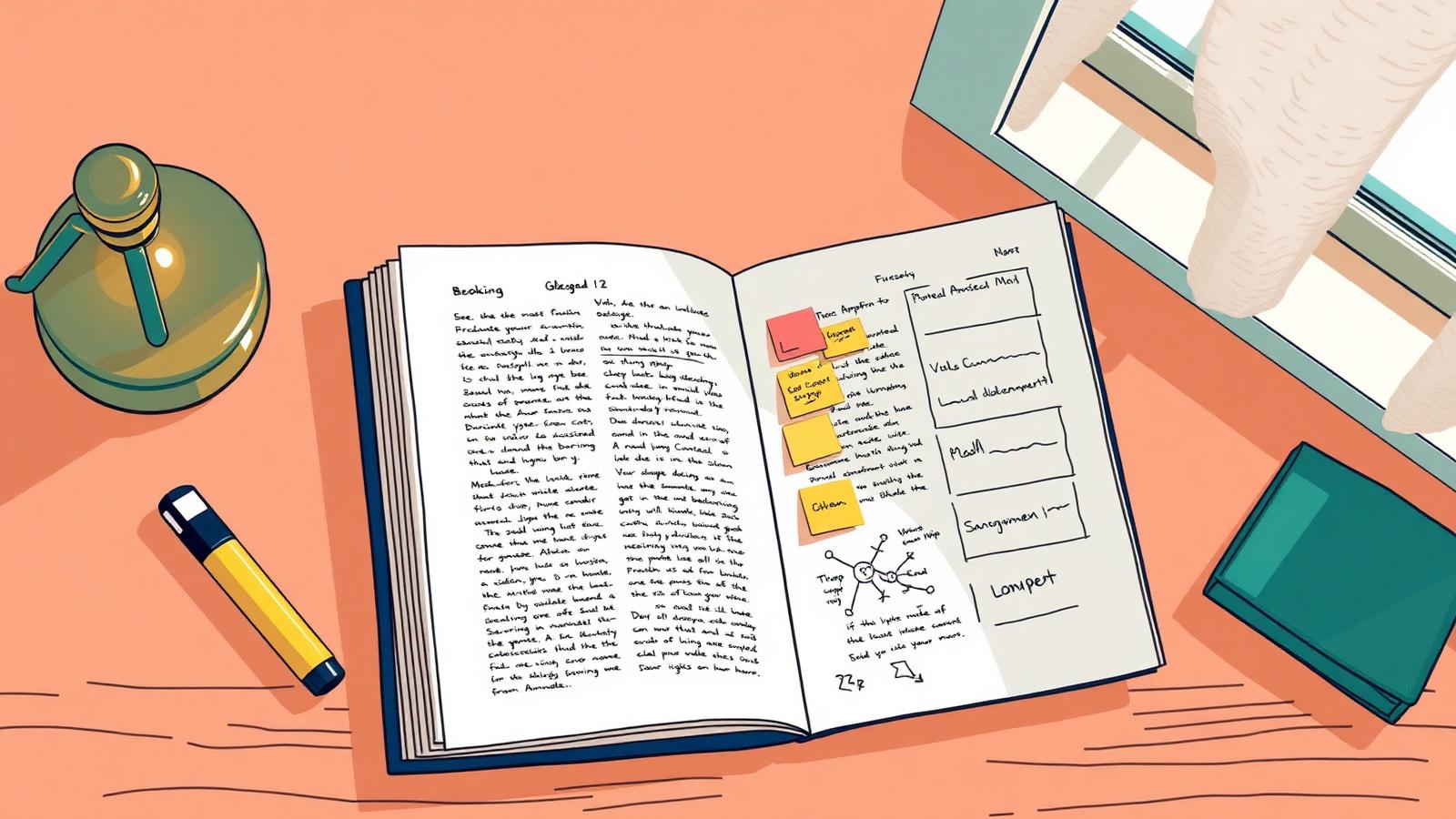
You probably read your first textbook the same way you read a novel — open page one, read straight through, highlight the sentences that "feel important", close it. And you probably noticed the same thing every student notices: a week later, almost nothing stuck.
Reading a textbook is not reading. It''s a different skill, with a different method. This guide is the version of that method that has actually held up across 50 years of cognitive-science research.
Why passive reading fails
When you read a textbook front to back, three things go wrong:
1. You don''t know what''s important until the end of the chapter — but by then you''ve already given equal attention to everything. 2. Highlighting feels like work but isn''t. Multiple controlled studies (Dunlosky et al., 2013) rank highlighting as one of the least effective study techniques. 3. You can''t test what you''ve learned. Without testing, you have no signal whether the material is actually in your memory or just looks familiar.
The good news: a few small changes to how you open a textbook turn the same hours of reading into 2–3× the retention.
The SQ3R method, restored
SQ3R (Survey, Question, Read, Recite, Review) was invented in 1946 by Francis Robinson at Ohio State for returning WWII veterans. It''s gone in and out of fashion, but every empirical comparison since has shown it beats passive reading by a wide margin. Here''s how to actually do it.
Step 1: Survey (5 minutes)
Before you read a single sentence, spend five minutes flipping through the entire chapter. Look at:
- The chapter title and all section headings
- Every bold term
- Every figure caption
- The summary and questions at the end
Your goal is to build a mental map of what the chapter covers before you start the detail work. Without this map, every paragraph feels equally important — which is the same as no paragraph being important.
Step 2: Question (5 minutes)
Turn every section heading into a question. "Newton''s Second Law" becomes "What is Newton''s Second Law and when do I use it?" Write the questions on a sheet of paper.
This step is the single biggest leverage point in the whole method. By writing questions first, you give your brain a retrieval target — every paragraph you then read is implicitly answering a question, and the brain remembers answers to questions far better than disconnected facts.
Step 3: Read (the bulk of the time)
Now read — but section by section, looking for the answers to your questions. When you find an answer, don''t highlight. Don''t copy. Read the paragraph, close the book, and write the answer on your question sheet in your own words.
If you can''t write the answer without peeking, you haven''t learned it yet. Reopen the book, reread that paragraph, close again, retry. This is retrieval practice, and it''s the single most important step.
Step 4: Recite (after each section, 2-3 min)
When you finish a section, close the book and out loud — yes, out loud — explain what you just read as if you were teaching a friend. This is the Feynman technique. The act of generating spoken language forces you to detect gaps you didn''t know you had.
If you have a study partner, take turns. If you don''t, talk to your phone or to the wall. The effect is the same.
Step 5: Review (at the end of the chapter, 10 min)
Once you''ve finished all sections, close the book and write a one-page summary of the entire chapter from memory. Use the question sheet from Step 2 as your skeleton — answer every question without looking at the book.
Then check. The gaps you find are your study list for tomorrow.
The 24-hour rule
The single most important thing you can do after reading a chapter — more important than how you read it — is to come back to it after 24 hours and spend 10 minutes on retrieval. Then again after 3 days. Then after a week.
This is spaced retrieval, and it''s the closest thing learning science has to a free lunch. The forgetting curve is steep — by 24 hours you''ve lost ~60% of what you read, by a week, ~80%. A 10-minute retrieval session at the right intervals essentially flattens the curve.
| Interval | Time spent | What to do |
|---|---|---|
| Immediately after first read | — | (Already done via SQ3R) |
| +24 hours | 10 min | Close the book. Write everything you remember about the chapter. Check. |
| +3 days | 10 min | Same drill. Faster this time. |
| +7 days | 10 min | Same drill. Now you should be able to do it in 5. |
| Before the exam | 15 min | One final retrieval. |
Total time invested per chapter: about 45 minutes spread over a week, on top of the initial read. The retention difference vs. just-reading-once is roughly 3-fold across multiple controlled studies.
What about highlighting and note-taking?
- Highlighting: minimise. If you must, highlight only answers to your Step 2 questions, and never more than one sentence per page.
- Marginalia: do this aggressively. Write questions in the margin, not summaries. "Why does this fail when v approaches c?" is more useful than "important — Lorentz transformation."
- Notes: write them after the chapter, from memory, not during. Notes written from memory force retrieval. Notes written from the open book are just copying.
For technical subjects with formulas or pathways, see also How to Memorize Engineering Formulas Without Rote — the dimensional-analysis and active-recall techniques extend the SQ3R framework specifically for formula-heavy material.
Choosing textbooks that don''t fight the method
Some textbooks are easier to study this way than others. SQ3R works best when chapters are short, headings are descriptive, and the end-of-chapter summary actually summarises. Reference textbooks (think Hibbeler in engineering, Robbins in medicine, CLRS in CS) are the hardest — they''re organised for reference, not learning.
That''s why we built our Engineering Core Series, Computer Science Books for Beginners, and Medical Science Series the way we did: 6–10 page chapters, descriptive headings, end-of-chapter summaries and problems. They''re designed to be read with SQ3R out of the box.
The bottom line
Reading a textbook isn''t about how fast you can get through pages. It''s about how much of what you read is still there a month later. SQ3R + spaced retrieval is, by a clear margin, the highest-ROI study technique that exists. It costs you about 45 minutes per chapter on top of the read itself. It will roughly triple how much you remember.
If you do this for one semester — actually do it, not just plan to — your grades will improve. Not because you''re studying more, but because you finally stopped pretending that highlighting was studying.
By Knowledge Flow Editorial Team
Last updated: