How to Study Chemistry: A Self-Study Guide That Actually Works
A step-by-step method for self-studying chemistry from the periodic table to organic mechanisms — what to read, what to skip, and how to make it stick.
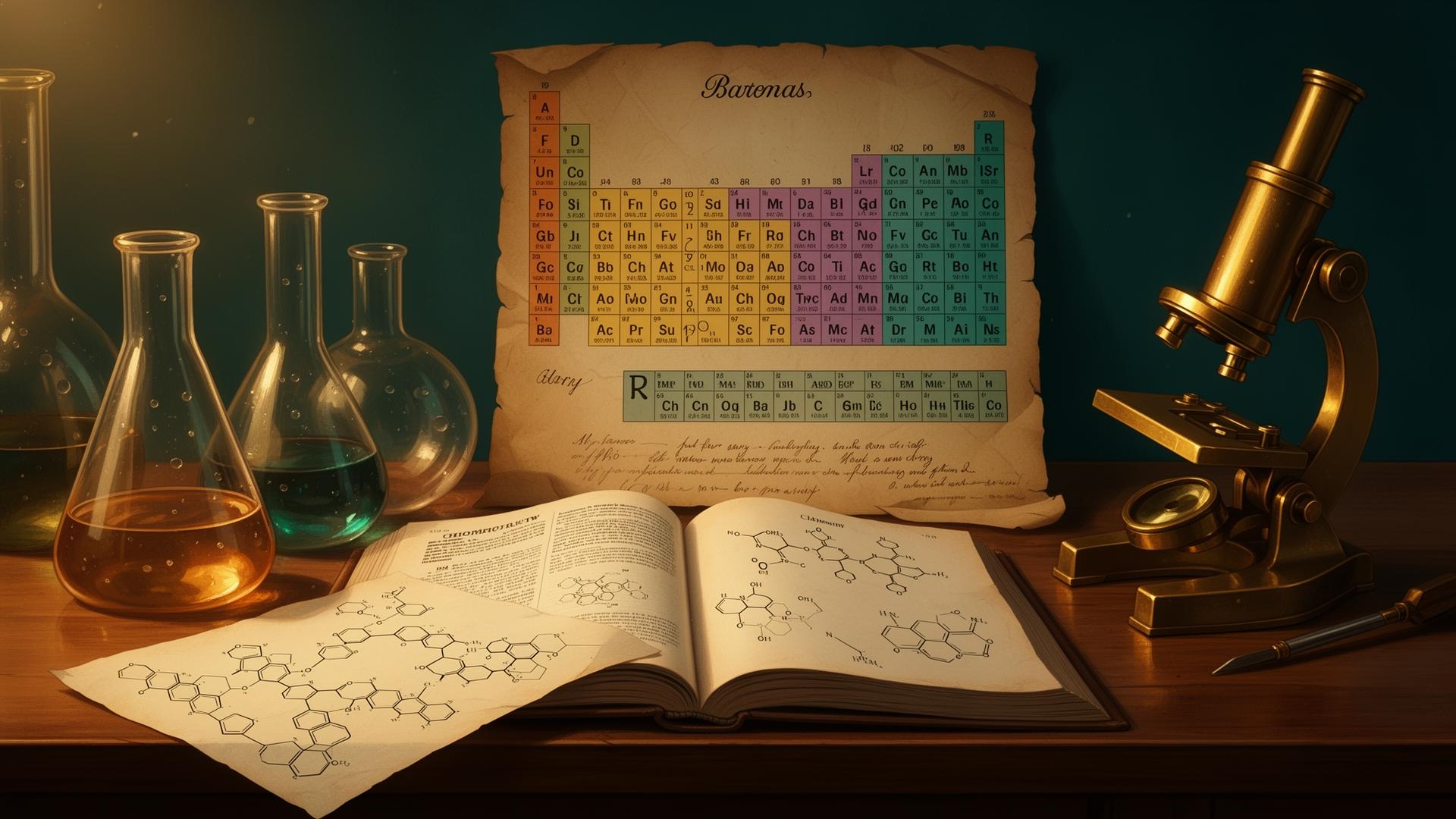
Most people who say they "hate chemistry" were taught it as a list of facts to memorise. It isn''t. Chemistry is a small set of rules — electrons want to be paired, charges want to balance, energy wants to be lowest — applied over and over to different combinations of atoms. Once that clicks, the subject becomes almost playful. Until it clicks, it feels like learning a thousand unrelated tricks.
This guide is for anyone studying chemistry on their own: a school student trying to catch up, a first-year university student preparing for entrance exams, or an adult learner returning to the subject. The path is the same. The only question is how long you want it to take.
Build the foundation in the right order
Chemistry has a strict dependency tree. Skip a step and the next one will feel impossible.
| Stage | What to learn | Why it matters |
|---|---|---|
| 1 | Atomic structure and the periodic table | Every other concept depends on where electrons live |
| 2 | Bonding (ionic, covalent, metallic) | Explains why molecules exist at all |
| 3 | Stoichiometry and moles | The arithmetic of every reaction |
| 4 | States of matter and gases | Connects physical and chemical behaviour |
| 5 | Thermodynamics and equilibrium | Why reactions go forward, backward, or stop |
| 6 | Acids, bases, redox | The two most common reaction families |
| 7 | Organic chemistry | A separate language; build it on top of bonding |
| 8 | Inorganic blocks (s, p, d, f) | Pattern recognition across the table |
Start at stage 1 even if you "already know it." A weak foundation will haunt you in organic chemistry six months from now.
The textbooks worth owning
For self-study you need one foundation text, one organic text, and one reference for the periodic table and reactions.
- Basics of Chemistry — covers atomic structure, bonding, stoichiometry, and physical chemistry at a pace that does not assume a teacher in the room.
- Introduction to Organic Synthesis — once you understand bonding, this gets you reading reaction mechanisms instead of memorising them.
- Medicinal Chemistry — for learners heading toward pharmacy, medicine, or pharmacology, this is where chemistry starts to feel useful.
If chemistry is part of a broader science foundation, our Science Foundation Series is the full shelf — physics, chemistry, biology, and mathematics designed to work together.
The daily study loop
Chemistry punishes passive reading more than almost any other subject. A loop that works:
- Read 10 pages. Slowly. Stop at every equation and reproduce it on paper.
- Write the rules in your own words. Not the textbook''s words. Yours.
- Solve 5 problems. Start with worked examples, then attempt unworked ones.
- Check, don''t just look. If you got one wrong, redo it from scratch the next day before moving on.
- End with a one-sentence summary of what the section is really saying.
One hour of this beats three hours of highlighting.
Organic chemistry needs its own strategy
Organic is where most self-learners give up. The trick is to stop memorising reactions and start memorising mechanisms.
- Learn the four arrow types: bond forming, bond breaking, lone pair to bond, bond to lone pair.
- Learn the four reaction families: substitution, elimination, addition, condensation.
- Every "named reaction" you''ll meet is one of those four, dressed up.
- Practise drawing the mechanism for every reaction you read about, not just the products.
A student who can push arrows confidently can derive most of an organic chemistry exam from first principles. A student who memorises product lists is one unfamiliar substrate away from a blank page.
How to make it stick
Three habits separate self-learners who finish from those who quit:
- Spaced repetition for facts only. Use flashcards for things that must be memorised — pKa values, oxidation states, common reagents. Do not flashcard concepts.
- A reaction notebook. One page per reaction class. Conditions, mechanism, common substrates, common pitfalls. Re-read it weekly.
- Past papers from week one. Don''t wait until you "finish the syllabus." You never will. Start solving real questions as soon as you''ve covered the relevant chapter.
Common mistakes to avoid
- Watching videos instead of solving problems. Videos feel productive; they aren''t.
- Buying five books. You will read none of them. Buy one, finish it, then decide.
- Skipping units and significant figures. Examiners punish this more than wrong answers.
- Treating organic and inorganic as two unrelated subjects. They share the same bonding rules.
Final word
Chemistry rewards the patient. The student who reads slowly, solves problems daily, and reviews weekly will, in nine to twelve months, go from struggling with the periodic table to comfortably reading organic mechanisms. There is no shortcut, but there is also no mystery. Pick a book, sit down, and start at stage 1.
The atoms have been waiting.
By Knowledge Flow Editorial Team
Last updated: