
How to Self-Study Data Structures and Algorithms in 2026
A focused six-month plan for learning data structures and algorithms on your own in 2026 — what to study each month, how to practice, and the one book that should sit on your desk the whole way through.
Data structures and algorithms (DSA) is the part of computer science most self-taught developers either avoid for too long or spend two years grinding without a plan. Neither extreme works. The good news is that DSA is one of the few topics where a structured six-month plan, a single reliable book, and roughly forty problems a month is genuinely enough to reach interview-ready competence.
This roadmap is opinionated. It will not list every data structure that exists. It will tell you what to learn, in what order, how to know you have learned it, and when to stop and move on.
Why DSA still matters in 2026
Every few years someone announces that DSA interviews are dead and that "real engineering" has moved on. They are partly right and mostly wrong. What has actually happened is this:
- The bar for the top fifty companies has not moved. If anything, it has crept up because the average candidate now arrives pre-trained on common problems.
- The bar for everyone else has moved toward "applied DSA": can you pick the right data structure for a real problem, reason about its cost, and write the code without a tutorial open in the next tab.
- Reading other people's code — frameworks, open source, internal codebases — is dramatically easier once you recognise the shapes. A queue is a queue whether it is in your interview or in a job scheduler.
You are not learning DSA to pass a quiz. You are learning it so that you stop being afraid of unfamiliar code.
The one book to anchor the whole journey
Most self-learners fail DSA because they bounce between four tutorials, three YouTube channels, and a problem set, and never finish any of them. Pick one book and read it cover to cover, in order, while you practise.
We recommend Data Structures and Algorithms from the Knowledge Flow catalog. It is deliberately compact, uses pseudocode you can translate to any language, and ends each chapter with problems that actually test the chapter — not a random difficulty wall. Pair it with whichever language you already know best; the book is language-neutral by design.
If you have not committed to a language yet, do that first. Our backend self-study roadmap covers that decision in detail, and the C++ roadmap is the right companion if you want a language that forces you to think about memory while you study DSA.
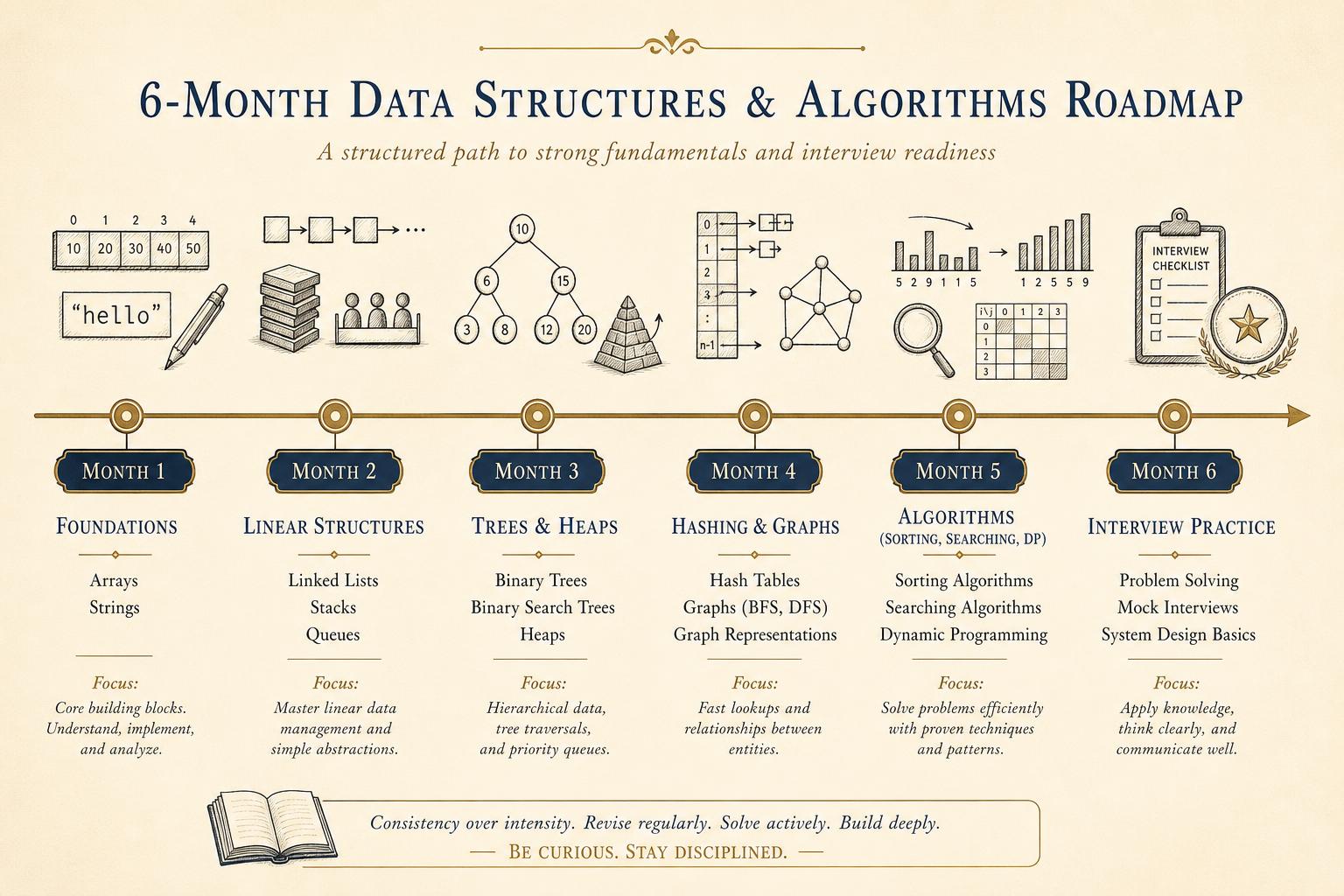
A 6-month plan that actually works
The plan assumes about ten focused hours a week. Less than that and you will forget faster than you learn. Significantly more is fine but not required.
| Month | Theme | What to learn | How to know you are done |
|---|---|---|---|
| 1 | Foundations | Arrays, strings, complexity, recursion | You can analyse any small function's time and space without guessing |
| 2 | Linear structures | Linked lists, stacks, queues, deques | You can implement each from scratch without looking |
| 3 | Trees and heaps | Binary trees, BSTs, tree traversals, heaps, priority queues | You can write iterative and recursive traversals on a whiteboard |
| 4 | Hashing and graphs | Hash tables, BFS, DFS, graph representations, shortest paths | You can model a real problem (e.g. a friend network) as a graph |
| 5 | Algorithms | Sorting, searching, greedy, divide and conquer, dynamic programming | You can recognise a DP problem within five minutes of reading it |
| 6 | Interview practice | Mock interviews, mixed problem sets, basic system design | You can explain your solution out loud while you write it |
The themes are sequential on purpose. Month 4 is much easier when month 2 is reflex. Month 5 is bearable only because month 1 made complexity analysis automatic.
Month-by-month details
Month 1 — Foundations
Spend the first week on Big-O. Not memorising a table — actually deriving the complexity of small functions until it stops feeling like a separate skill. Then move to arrays and strings, where every "trick" you will ever need (two pointers, sliding window, prefix sums) is born.
End the month by re-implementing your language's built-in array operations. If you can write your own `indexOf`, `slice`, and `map` without checking the docs, you understand arrays.
Month 2 — Linear structures
Linked lists, stacks, and queues are where most people first feel competent. Implement each one from scratch. Then implement them again using a different underlying structure (a stack on top of two queues, a queue on top of a linked list). The point is not the exercise — it is realising that data structures are agreements about behaviour, not specific layouts in memory.
Month 3 — Trees and heaps
Trees are the first place where recursion becomes natural rather than scary. Write every traversal (preorder, inorder, postorder, level-order) both recursively and iteratively. Once you understand why the iterative version needs a stack, you understand recursion.
Heaps are short but worth the time. They unlock priority queues, which unlock a surprising number of "hard" problems that turn out to be one heap away from easy.
Month 4 — Hashing and graphs
Hash tables are the workhorse of real engineering. Learn how collisions are handled, why load factor matters, and when a hash map is the wrong answer (ordered iteration, range queries).
Graphs scare people because they look like a separate subject. They are not — a graph is just nodes that point at each other. BFS and DFS are the only two traversals you need this month. Model three real things as graphs (a city's metro map, a dependency tree, a social network) and the abstraction will click.
Month 5 — Algorithms
This is the heaviest month. Pace yourself.
- Sorting: implement merge sort and quicksort once, then never again. Understand stability and when it matters.
- Searching: binary search and its variants (first occurrence, last occurrence, rotated arrays). Most "medium" interview problems are a binary search wearing a costume.
- Greedy: easy to write, hard to prove correct. Always ask "what is the counter-example?"
- Dynamic programming: the part everyone fears. Start with one-dimensional problems (climbing stairs, house robber) and only move to 2D when 1D is boring.
Month 6 — Interview practice
Stop learning new structures. Mix problems across all five previous months, time yourself, and talk out loud while you solve. Record yourself if you have no partner. The gap between "I can solve this" and "I can explain this while solving it" is larger than you think and only closes with practice.
How to practise without burning out
- Forty problems a month, not four hundred. Quality dominates quantity after the first few weeks.
- Re-solve old problems. A problem you solved two months ago and can still solve in fifteen minutes is worth ten new ones.
- Write the solution before you write the code. Pseudocode in a notebook first. If you cannot write the pseudocode, you do not understand the problem yet.
- Read other people's solutions only after you finish your own. Reading first short-circuits the part of your brain you are trying to train.
What to skip
Some things look essential and are not, at least not on the first pass.
- Red-black trees, AVL trees, B-trees. Worth knowing they exist. Not worth implementing unless you are writing a database.
- **Advanced graph algorithms (Dijkstra''s variations, max-flow, A\*).** Learn them when a real problem demands them.
- Competitive programming tricks. Different sport. Useful skills, but they will not help you write better production code.
What comes after
When the six months are over, you have two natural next steps. If you want to ship things, dive into the backend developer roadmap and start building APIs on top of the structures you now understand. If you want to go deeper into the machine, work through the best engineering foundation books — operating systems, networks, and compilers are easier and more interesting once DSA is reflex.
Either way, keep Data Structures and Algorithms on the shelf. You will reach for it again the first time a "simple" production bug turns out to be a wrong choice of data structure three years ago.
Browse the full catalog for the rest of the journey.
By Knowledge Flow Editorial Team
Last updated: